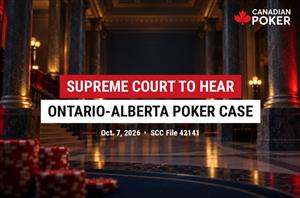
Alberta joins Ontario in the Supreme Court case on shared online poker liquidity.
The case could impact the future of regulated markets in Canada.
A successful outcome for Ontario might lead provinces to adopt shared liquidity models for online poker.
The legal battle over online poker liquidity in Canada is no longer just an Ontario story.
Alberta has now joined the Supreme Court of Canada proceedings tied to Ontario’s proposed shared-liquidity model for online gambling, adding more national weight to a case that could help define the future of regulated online poker in this country. While some early reporting pointed to April 14, the Supreme Court record shows Alberta was granted leave to intervene on April 13, 2026.
For poker players, the issue is straightforward even if the law behind it is not. The case turns on whether Ontario can lawfully allow players in its regulated market to take part in pooled games involving players outside the province, and potentially outside Canada, while still meeting the Criminal Code requirement that the province “conduct and manage” the scheme.
Why Poker Is at the Centre of It
Liquidity is the engine of online poker. Without it, player pools stay smaller, game selection gets thinner and tournament guarantees are harder to build. That has been one of the central limits of Ontario’s current ring-fenced market, where peer-to-peer poker has been regulated inside provincial borders rather than connected to broader international pools.
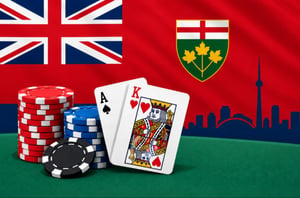
Ontario has already won an important round. In a 4-1 decision, the Ontario Court of Appeal held that the province’s proposed model could still comply with the Criminal Code even if Ontario players competed against players in foreign jurisdictions through approved arrangements. That ruling gave Ontario a significant opening, but the matter did not end there. It is now before the Supreme Court of Canada after further appeals from other
Alberta’s Move Matters
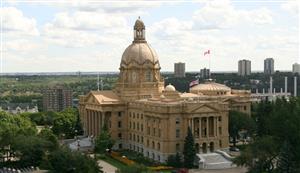
Alberta is not leading the appeal, but its entry as an intervener matters all the same.
The province is preparing to launch its own commercial iGaming market on July 13, 2026, which makes the outcome of this case far more than academic from its point of view. If Ontario ultimately succeeds, Alberta could have a clearer legal foundation to consider shared poker liquidity in its own market rather than starting from a closed provincial pool.
That is what makes this development so important for Canadian players. The question is no longer whether Ontario alone can make a bigger poker market work. It is whether Canada’s next regulated provinces will be able to build something broader and more competitive than a collection of isolated pools.
The Wider Regulatory Picture
This case sits right at the intersection of policy ambition and legal restraint.
On one side is the commercial and competitive reality of poker. Shared liquidity is widely seen as essential for healthier ecosystems, especially in jurisdictions that do not have massive standalone player populations. On the other is the Criminal Code framework that allows provinces to run gaming, but only if they remain the party truly conducting and managing the scheme. That tension is now being tested at the highest judicial level in the country.
Ontario has already signalled that international liquidity is a meaningful part of the long-term vision for its regulated market. iGaming Ontario’s own reporting has pointed to pooled liquidity as a material policy and commercial issue, especially for peer-to-peer products like poker.
What It Could Mean for Players
If the Supreme Court ultimately backs Ontario’s position, the immediate effect will not be a switch flipped overnight. Operators would still need regulatory approval, commercial agreements and technical arrangements to connect markets in practice. But the legal barrier would be much lower, and that would matter a great deal.
For players, the upside is obvious: larger fields, more reliable game availability, stronger tournament schedules and prize pools with a better chance of competing internationally. For provinces like Alberta, it could also shape how attractive a future regulated market looks from day one.
If the court goes the other way, Canada’s regulated poker market is far more likely to remain fragmented. Ontario would stay boxed into a closed model for peer-to-peer poker, Alberta would face similar structural limits, and the prospects for a more connected national online poker ecosystem would take a serious hit. That is why this case now carries weight well beyond legal circles. It could determine whether regulated online poker in Canada stays provincial, or finally starts thinking bigger.