WPT Seoul Qualifiers Start at $1.10 on WPT Global
18 Aug 2026Read More
Phenom Poker’s $PHNM Token Pivot Signals Economic Reset
- Phenom Poker transitions from fixed-price to floating $PHNM token.
- Shift eliminates treasury strain, aligns token value with market forces.
- Players now stakeholders; potential growth vs. volatility risks.
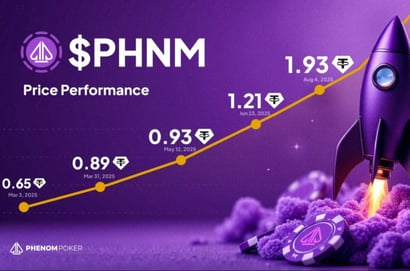
Phenom Poker has replaced its fixed-price token system with a floating $PHNM model. The change removes treasury pressure, converts players into stakeholders, and introduces volatility risk.
In crypto gaming, innovation often masks structural repair. Alec Torelli recently outlined Phenom Poker’s shift from a fixed-price token system to a publicly traded $PHNM token, describing it as a crypto-style IPO.
The move is not cosmetic. It represents a response to an unsustainable economic design that was actively draining platform reserves.
Why the Original $PHNM Model Failed
Phenom Poker’s earlier token system guaranteed buybacks at a fixed price. This forced the platform to defend token liquidity using its treasury.
Each player exit reduced available capital. Funds that should have supported growth, marketing, and liquidity expansion were instead locked into maintaining redemptions. In financial terms, the system mirrored a failing currency peg.
Floating Token Economics Explained
By allowing $PHNM to trade freely, Phenom removes its obligation to defend price levels. Market supply and demand now determine token value.
This shift aligns Phenom with basic financial mechanics. Capital is no longer reserved for exits. Treasury funds can be redirected toward platform development and player acquisition.
Players Become Stakeholders
Torelli compared the new structure to an IPO. The comparison holds, but with consequences. Players no longer interact with the platform purely as customers.
Token holders now function as stakeholders. Rakeback effectively becomes a dividend. If the platform grows, token value rises alongside player activity.
Upside of the $PHNM Token Model
If Phenom scales into a high-volume poker platform comparable to GGPoker, early $PHNM holders benefit directly. Rake generated by players feeds token value. Incentives align between liquidity, play volume, and long-term participation.
Downside Risk and Volatility
Token pricing introduces volatility into player bankrolls. A decline in trading volume or market sentiment can erode token value. When this happens, advertised rakeback rates lose real value. Poker variance extends beyond the tables and into account balances.
The Redemption Freeze Controversy
The most contentious issue is the temporary freeze on redemptions during the transition period.
While logically intended to prevent a liquidity run, freezing funds undermines trust. For a platform promoting decentralized ownership, unilateral action exposes centralised control. The absence of player voting on a structural change contradicts core Web3 principles.
A Necessary but Risky Reset
Torelli is correct in one respect. The original model could not scale. A poker platform cannot grow while serving as an exit liquidity pool.
Phenom is betting that long-term equity participation and yield will offset short-term disruption. Players are being asked to treat balances as investments rather than cash.
If the token appreciates, the pivot marks Phenom’s maturation. If not, players may conclude they were speculating without control.
Key Insights for Players and Token Holders
| Feature | Old model (Fixed) | New Model (Floating) |
|---|---|---|
| Token Value | Artificial/Pegged | Market Driven |
| Risk Profile | Low (until treasury failure) | High (Market volatility) |
| Primary Incentive | Stability | Revenue Share & Growth |
| Sustainability | Low (Drains Treasury) | High (Protects Treasury) |
Upcoming Events
29 September 2026
WPT Australia 2026 Poker
Cards in the Air in Sydney: WPT Australia 2026 Announces Massive Three-Week Schedule
Unibet Open Marrakech Poker
Unibet Open Marrakech 2026 Set to Ignite Eleven-Day Autumn Poker Festival
Malta Poker Festival Autumn Edition Poker
Massive €3 Million Prize Pool Guaranteed for Autumn Edition of Malta Poker Festival
WSOP Circuit Playground November 2026 Poker
WSOP November Circuit Stop at Playground Kicks Off on November 2
APT Championship Taipei 2026 Poker
APT Championship 2026 to Feature 210 Tournaments and Massive Guarantees
30 October 2026
Poker EventsStarts in
Latest News
-
 WPT Seoul
 -
$18M On OfferGGPoker is Ready with $18M October Giveaway Across Promotions28 Sep 2026Read More
-
PokerStarsWCOOP Update Report: Benny Glaser Strikes Twice In Single Session & Canadian Results28 Sep 2026Read More
-
FT #3Negreanu Makes Third WSOP Online Final Table But Misses Bracelet28 Sep 2026Read More
-
Premium NLH & PLONo Rest for Grinders: ACR Follows $50M OSS XL With $6.5M Dual Venom PKOs28 Sep 2026Read More