
WPT Seoul Qualifiers Start at $1.10 on WPT Global
18 Aug 2026Read More
One Big Beautiful Bill Act: Impact on Poker
- OBBBA reduces U.S. gambling loss deductions from 100% to 90%, effective 2026.
- Professional gamblers face higher tax liabilities, risking shifts to offshore betting.
- Industry stakeholders, including the AGA, seek legislative adjustments.
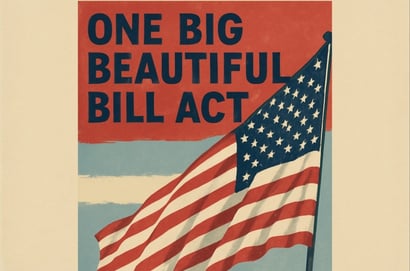
The One Big Beautiful Bill Act reduces gambling loss deductions to 90%, significantly affecting professional poker players and sports bettors. Industry figures warn this could raise taxes, disrupt regulated markets, and push more players toward offshore gambling platforms.
The One Big Beautiful Bill Act (OBBBA) introduces a major adjustment to U.S. gambling tax policy by limiting loss deductions to 90% of annual winnings.
The change, set to take effect in 2026, is expected to significantly affect professional poker players and sports bettors.
Legislative Status
The U.S. House of Representatives has passed the OBBBA, and the bill is currently awaiting the signature of President Donald Trump.
Among its many provisions, one clause in particular has drawn considerable attention from the gambling industry.
It amends the Internal Revenue Code by reducing the proportion of gambling losses that can be deducted from winnings in a tax year.
New Deduction Limits
Under existing law, bettors can offset 100% of their gambling losses against their winnings. The OBBBA reduces this allowance to 90%, meaning that even a break-even year could result in taxable income.
This adjustment will directly impact the tax liabilities of those engaged in professional gambling activities.
The change is scheduled to take effect on January 1, 2026, and could lead to situations where players owe taxes despite making no net profit or even experiencing an overall loss.
Example Scenarios:
- A player who wins $100,000 and loses $100,000 in the same year would currently owe no taxes. Under the OBBBA, they could deduct only $90,000 of their losses, resulting in $10,000 in taxable income.
- In a case where a bettor wins $200,000 but loses $210,000, only $189,000 of the losses would be deductible. This would leave $11,000 as taxable income despite the player’s actual net loss.
Impact on Professional Players
Professional poker players and sports bettors, who often operate on narrow margins, rely on full deductibility to manage risk and maintain profitability.
Reducing the allowable deductions could substantially increase their annual tax burdens.
For instance, under current tax rules, a professional with $1.1 million in winnings and $1 million in losses reports $100,000 in taxable income.
Under the OBBBA, the same figures would result in $200,000 in taxable income, effectively doubling the tax liability.
Industry Reaction to the Proposed Change
The new deduction framework has generated immediate concern among industry stakeholders.
Professional poker player Phil Galfond has publicly warned that the measure could make professional gambling financially unsustainable in the United States.
“You can't be a professional gambler in the U.S. if this goes through and that will have a ripple effect on industries that depend on professionals,” Galfond said in a video on X.
He also predicted that more players may shift to offshore betting sites and noted the potential consequences for poker and Daily Fantasy Sports (DFS) operators.
Political Response from Nevada Representation
Congresswoman Dina Titus, who represents Nevada’s first district, including Las Vegas, expressed similar concerns in an interview with News Nation. She cautioned that the measure could increase the appeal of unregulated gambling.
“It pushes people into the black market if they don't do regulated gaming because they have a tax disadvantage,” Titus said.
She warned that such a shift could reduce tax revenues and increase the risk of problem gambling. Titus also indicated she may pursue legislation to reverse the 90% deduction limit.
American Gaming Association’s Position
The American Gaming Association (AGA), representing U.S. casino industry interests, has expressed general support for the OBBBA.
The organization praised the bill’s broader tax provisions for supporting consumers, encouraging investment, and strengthening competitiveness.
“We commend congressional leaders on the passage of the One Big Beautiful Bill Act,” the AGA stated. However, the group acknowledged concerns about the new loss deduction rule and confirmed it will work with lawmakers to address this specific provision while continuing its advocacy for a modernized gambling tax code.
Outlook for Poker and Betting Communities
With the bill now awaiting presidential approval, professional gamblers and industry operators are evaluating its likely effects.
If enacted without amendments, the OBBBA’s gambling loss deduction limit will apply from January 2026, requiring players and operators to adapt to potentially higher tax burdens.
Industry stakeholders are closely watching for any legislative initiatives that might modify or repeal the provision.
In the meantime, both professional poker players and sports bettors will need to plan for the financial adjustments required under the new framework.
Upcoming Events
17 October 2026
Malta Poker Festival Autumn Edition Poker
Massive €3 Million Prize Pool Guaranteed for Autumn Edition of Malta Poker Festival
WSOP Circuit Playground November 2026 Poker
WSOP November Circuit Stop at Playground Kicks Off on November 2
APT Championship Taipei 2026 Poker
APT Championship 2026 to Feature 210 Tournaments and Massive Guarantees
30 October 2026
Poker EventsStarts in
Latest News
-
 WPT Seoul
 -
Security UpdateGGPoker Adds Security Features, Tightens Software Rules16 Oct 2026Read More
-
Poker Dreams Made TrueCoinPoker The One 2026 Results: Big Numbers, Bigger Stories16 Oct 2026Read More
-
FreebuyCanadianPoker Launches Weekly $100 GTD WPT Global Freebuys16 Oct 2026Read More
-
Final Rings AwardedSrinivas Gottiparthi and Dallas Larson Win Final WSOP Circuit Calgary Rings15 Oct 2026Read More